
Until now, cross-chain meant one thing on RelAI: an EVM-primary API with an optional Solana wallet attached. Buyers on Solana could pay into a Solana address; buyers on Base paid into an EVM address. The 402 response merged both. That worked well.
But the reverse wasn't supported. If your API lived on Solana — receiving SPL USDC, settling to a Solana address — you couldn't offer EVM users an on-chain payment path. They had to bridge first or not pay at all.
Both directions are now supported.What Changed
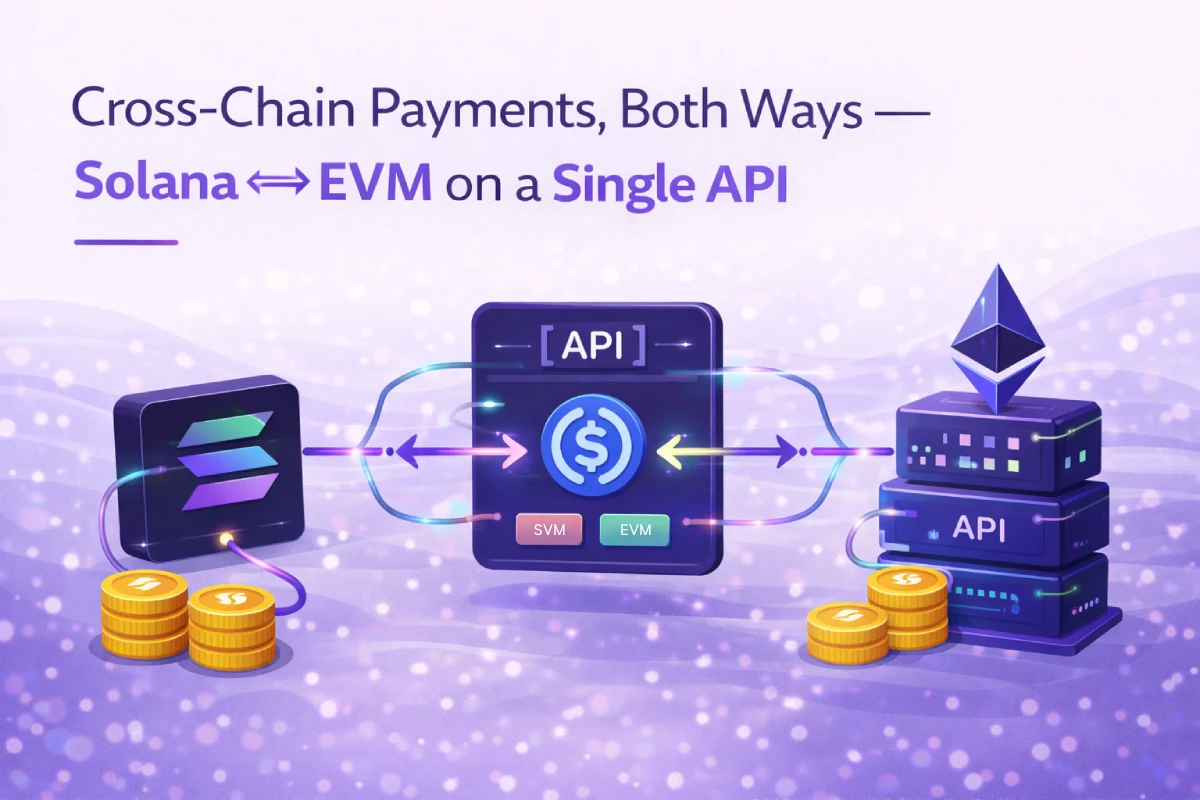
RelAI now builds cross-chain 402 responses for both payment families:
EVM primary → Solana cross-chain (existing, unchanged) Your API is on Base (or Polygon, Avalanche, etc.). You add a Solana wallet in the dashboard. The 402 response includes both EVM and Solana accepts. The buyer's SDK picks whichever matches their active wallet. Solana primary → EVM cross-chain (new) Your API is on Solana. You add an EVM wallet for cross-chain settlement. The 402 response includes Solana accepts (primary) and EVM accepts (cross-chain). A buyer on Base pays into your EVM address; a buyer on Solana pays into your Solana address.The API doesn't change. The endpoint doesn't change. The price doesn't change.
How the 402 Response Looks
For a Solana-primary API with EVM cross-chain enabled, the response looks like this:
HTTP/1.1 402 Payment Required
X-Payment-Required: [
  {
    network: "solana:mainnet",
    asset:   "USDC (SPL)",
    payTo:   "GH93t...your-solana-wallet",
    amount:  "10000"
  },
  {
    network: "eip155:8453",
    asset:   "USDC (Base)",
    payTo:   "0xAbCd...your-evm-wallet",
    amount:  "10000"
  }
]
Solana accepts come first — the primary network. EVM accepts follow. The client picks based on the connected wallet. No configuration required on the buyer's side.
Configuring Cross-Chain in the Dashboard
The Supported Payment Networks card now works for both primary families.
If your primary network is EVM:- Select your primary network (Base, Polygon, Avalanche, etc.)
- Enter your EVM owner wallet — this receives all EVM payments
- Click the Solana tile to enable Solana cross-chain
- Enter your Solana wallet address — this receives Solana USDC payments
- Select Solana as the primary network
- Enter your Solana owner wallet — this receives all Solana USDC payments
- Click any EVM network tile (Base, Polygon, Avalanche, etc.) to enable it as cross-chain
- Enter your EVM wallet address — this receives EVM USDC payments from those networks
From the SDK
Nothing changes on the client side. The RelAI SDK reads the 402 response and picks the payment option that matches the connected wallet:
import { createX402Client } from '@relai-fi/x402'

const client = createX402Client({
  solanaWallet: { publicKey, signTransaction },
  evmWallet: { address, signTypedData },
})

const response = await client.fetch('https://your-api.x402.fi/data')
// Solana wallet connected → pays via Solana USDC
// Base wallet connected  → pays via Base USDC
// Same API, same endpoint, same price
If the user has both wallets connected, the SDK prefers the primary network of the API. Cross-chain is a fallback, not a forced path.
Settlement
Each payment settles to the wallet configured for that network:
| Buyer network | Settles to |
|---|---|
| Solana | Your Solana wallet |
| Base | Your EVM wallet |
| Polygon | Your EVM wallet |
| Avalanche | Your EVM wallet |
| Ethereum | Your EVM wallet |
| Telos EVM | Your EVM wallet |
| SKALE Base | Your EVM wallet |
Why It Matters
Solana and EVM are the two dominant payment families in the x402 ecosystem. Until now, an API operator had to choose one as their primary and accept reduced reach from the other side.
With bidirectional cross-chain, that tradeoff is gone. A Solana-native API is now as accessible to a Base user as it is to a Phantom wallet holder. An EVM API is as accessible to a Solana user as it is to someone on MetaMask.
The liquidity is already there on both sides. Cross-chain removes the last step of friction between it and your API.
Cross-chain in both directions is live now. Configure your wallets in the dashboard under Supported Payment Networks.
Further Reading
Cross-Chain & Multi-Network
- Multi-Network Support — EVM multi-network: one API, every EVM chain
- Supported Networks & Facilitators — full compatibility matrix
Networks
- Solana Documentation — SPL tokens, Solana wallets
- Base Documentation — eip155:8453
- Polygon Documentation — eip155:137
- Avalanche Documentation — eip155:43114
- Ethereum Documentation — eip155:1
- Telos Documentation — eip155:40
- SKALE Documentation — SKALE Base, SKALE Bite sandbox
Protocol & SDK
- x402 payment protocol — HTTP 402 standard for machine-to-machine payments
- RelAI SDK on npm —
@relai-fi/x402 - RelAI documentation — quickstart and SDK reference
RelAI is the gas-sponsoring facilitator for the x402 payment protocol. We handle settlement, gas, and exchange rates — on Solana, on EVM, and across both.