
Recurring revenue is the backbone of most software businesses. Yet the moment you want to charge $9/month, you inherit a surprising amount of baggage.
The hidden cost of a "simple" subscription
Reach for Stripe (or any traditional processor) and the real checklist looks like this:
- You need a registered company and a bank account. Subscriptions presuppose a legal entity the processor can pay out to. That alone excludes a huge number of independent builders, especially outside a handful of supported countries.
- Your customer needs a card. Card penetration is far from universal, cards expire, and "involuntary churn" — failed renewals from expired or declined cards — quietly eats 5–10% of recurring revenue.
- Payouts are slow. You charge today; the money lands in your bank in 2–7 days. Your cash flow runs on someone else's schedule.
- You don't really hold your money. Funds sit with the processor. Accounts get frozen, reserves get held, and a single risk-model false positive can pause your entire business.
- Chargebacks and disputes put the merchant on the defensive by default.
- It's geographically gated. Onboarding, payout currencies, and supported regions are decided for you.
- It's not programmatic. An AI agent or an autonomous service can't open a Stripe account, pass KYC, and manage a subscription. The whole flow assumes a human with a bank.
This isn't the opposite of pay-per-use
We've written before about pay-per-use and the end of forced subscriptions — paying a fraction of a cent per request, no sign-up. That's still the right model for metered consumption and for agents that transact at machine speed.
Subscriptions solve a different problem: predictable, recurring access — a SaaS seat, a hosted instance, an API plan, a membership. Some value is naturally billed per period, not per call. So we built the recurring primitive to sit alongside pay-per-use, not replace it.
How RelAI subscriptions work
We didn't write a payment processor. RelAI builds on Solana's canonical, audited on-chain subscriptions program — a shared primitive, not something we deployed ourselves. Three steps:
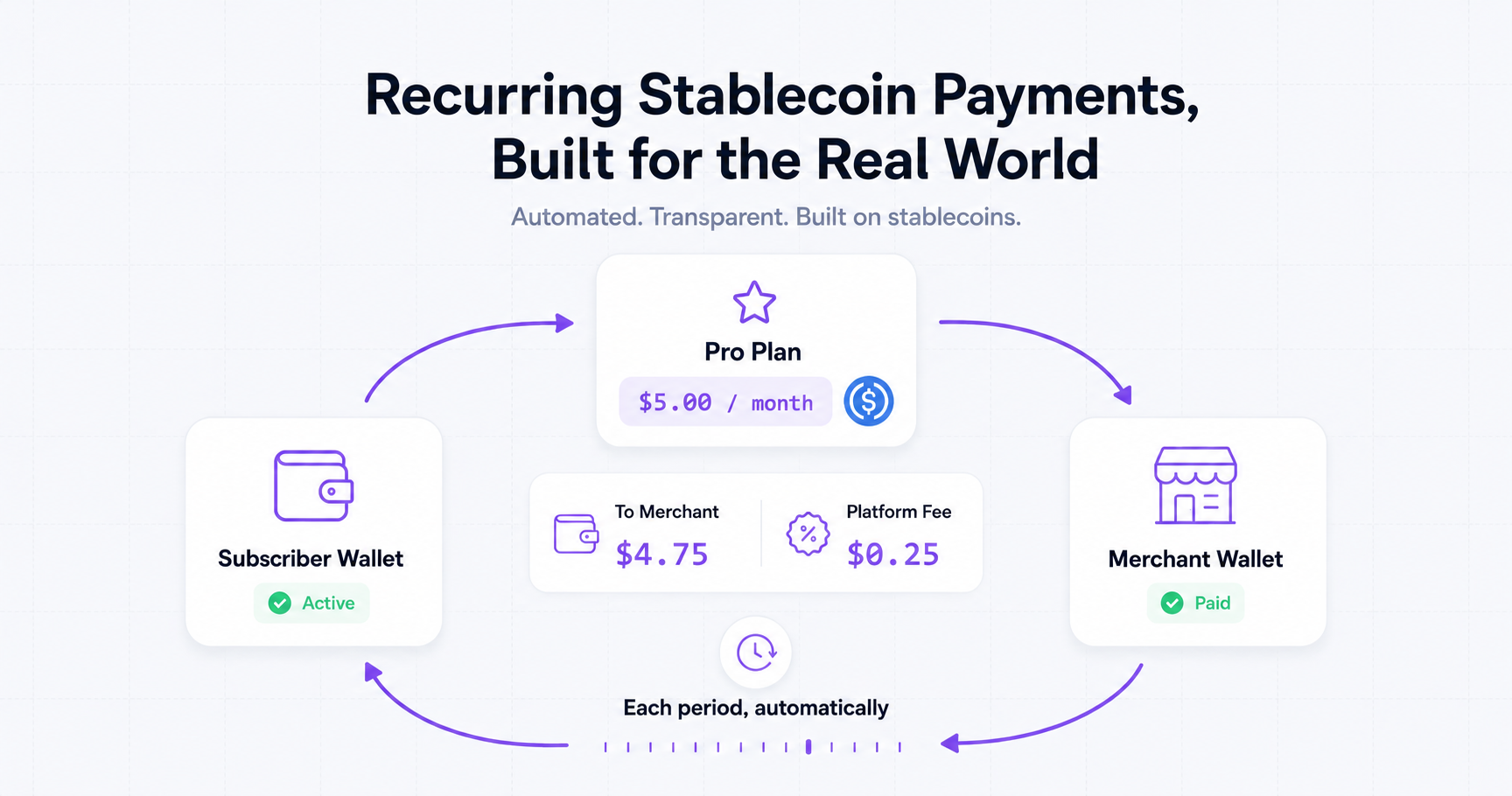
- You publish a plan. Price, period (e.g. monthly), and your payout wallet. It lives on-chain.
- A subscriber approves once. One wallet signature authorizes the program as a delegate and accepts your plan's terms. No account, no card, no recurring re-signing.
- Each period, the charge is pulled automatically. USDC moves directly from the subscriber to your wallet. RelAI never holds the funds — it only triggers the pull and pays the network fee.
What you get
- Non-custodial by construction. Money flows wallet-to-wallet, settled in seconds. No payout delay, no held reserves.
- Global and account-free. Anyone with a USDC wallet can subscribe. No company, no bank, no region gate.
- Two ways to attach value. Link a plan to a RelAI marketplace API (subscribers skip the per-call payment), or gate your own service — a web app, a VM, a SaaS — using a subscription-status check.
- Signed webhooks on every event —
subscription.created,subscription.charged,subscription.payment_failed,subscription.canceled— so you can provision or suspend infrastructure the moment a payment lands or lapses. - Built-in reporting. MRR, active subscribers, revenue collected, and per-plan charge history, straight from the dashboard.
- Agent-ready. Because subscribing is a wallet signature and status is an API call, an autonomous service can subscribe, get billed, and be gated — no human in the loop.
A note on the fee
RelAI takes a flat 5% of each charge, deducted in the same transaction as your payout — so on a $5 charge you receive $4.75, instantly, to your wallet. No monthly minimums, no setup fee, no separate invoice.
Where this fits
If you're shipping a SaaS, renting a hosted instance, selling recurring API access, or building an agent that needs a recurring budget — you can now do it with a shareable link and a single signature, and watch the USDC arrive in your own wallet each period.
Create your first plan in the dashboard, or read the subscriptions docs.
Recurring revenue shouldn't require a bank's permission. Now it doesn't.