
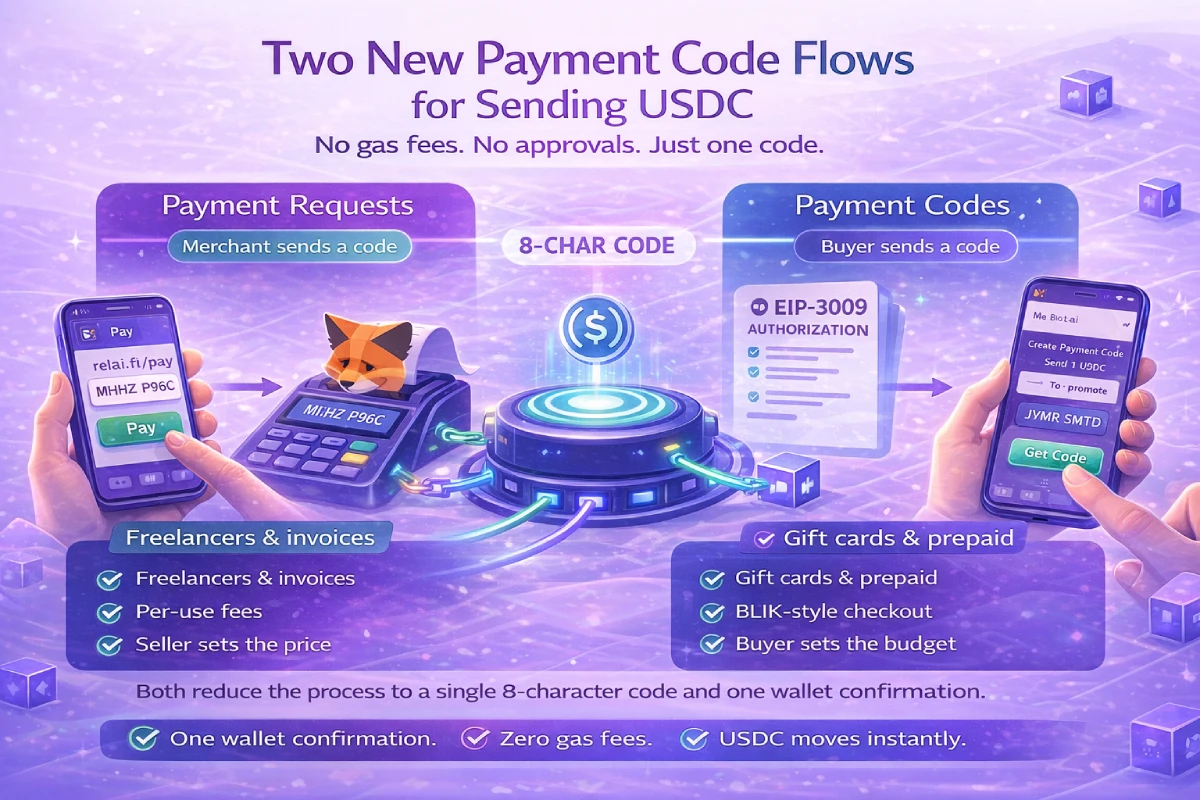
Sending USDC on-chain has always been more complicated than it needs to be. You need the right wallet, the right network, and usually two separate transactions just to move tokens to someone else. RelAI changes that with two new payment flows — both reduce the entire process to a short 8-character code and a single wallet confirmation.
No gas fees. No approval steps. USDC goes directly from the buyer's wallet to the merchant's wallet the moment they confirm.
Two Flows, One Idea
Think about how you pay for things in everyday life. Sometimes the merchant sends you an invoice — you pay the amount they specify. Other times you buy a gift card or a voucher upfront, then hand it to someone to redeem. Both are valid. Both are useful. They just serve different moments.
RelAI now supports both:
- Payment Requests — the merchant creates the code. They decide the amount and send the code to whoever needs to pay. The buyer enters the code in the payment gateway, sees exactly what they're paying and to whom, confirms in their wallet, and it's done.
- Payment Codes — the issuer creates the code. Like writing a cheque: they authorize the payment upfront, get a short code, and pass it to the merchant. The merchant redeems it whenever they're ready — no need for the issuer to be present at that moment.
Payment Requests: The Merchant Sends a Code
A merchant — or any developer building on RelAI — generates a payment request for a specific amount. They get back a short code like MHHZ P96C. They share it however they want: drop it in a chat message, put it on an invoice, print it on a QR code.
The buyer goes to relai.fi/pay, types in the code, and sees the amount and recipient clearly before doing anything. One wallet confirmation later, the money moves. The whole flow takes under a minute.
This works well for:
- Freelancers sending invoices
- Per-session or per-use fees
- Any scenario where the seller sets the price and the buyer just needs to pay it
Payment Codes: The Issuer Writes a Cheque
Think of this as a digital cheque. The issuer authorizes a payment for a specific amount to a specific recipient — but nothing moves yet. RelAI registers that authorization on SKALE and returns a short code. The issuer passes the code to the merchant.
When the merchant is ready, they redeem it. The USDC settles immediately — even if the issuer is completely offline at that point. The money was already committed the moment the code was created.
This works well for:
- Prepaid wallets and vouchers
- BLIK cheque-style flows: authorize on your phone, hand the code over at the counter
- AI agents pre-authorizing a budget before a task starts
Why It Works Without Gas Fees
On most blockchains, every on-chain action costs gas. Sending USDC on Ethereum might cost $1–5 in fees. Even on cheaper chains like Base or Polygon, there's always something to pay.
SKALE is different. Transactions on SKALE consume CREDITS — the network's internal gas token — which are distributed to operators and cost nothing to end users. There's no fee to top up, no ETH to keep in a wallet just to pay for transactions. The economics are simple: a $2 payment costs $2, not $2 plus fees.
This is what makes small payments viable. Charging $0.50 for a service makes no sense if the gas to collect it costs more than that.
What the Buyer Actually Sees
When a buyer opens a payment link and connects their wallet, MetaMask shows them a clear signing request: who they're paying, how much, and on which network. There's no hidden amount, no surprise network, no separate approval step beforehand.
The buyer sees what they're signing. They confirm once. Done.
Built to Be Safe
A few things are locked in on the server side so neither party can be surprised:
- The amount is fixed — a payment that arrives with a different amount than what was requested is rejected outright.
- The recipient is fixed — the USDC can only go to the wallet address on the original request. It can't be redirected.
- Codes expire — every payment request has a time limit. If it's not paid in time, it expires and can't be used.
- No double payments — once a code is being processed, any second attempt is blocked immediately.
What's Next
Both flows are running now as a proof of concept on SKALE Base Sepolia. On the roadmap:
- SKALE mainnet — same experience, real USDC
- QR codes — auto-generated QR for every payment code and request
- Merchant webhooks — get notified the moment a payment settles
- Branded pay pages — custom
/pay/your-brandlinks with your own look - One URL, two flows — a single link that figures out whether it's a request or a code automatically
Payment Requests and Payment Codes are the simplest way to accept USDC on-chain — no gas, no approvals, no friction. One code is all it takes.