
Gift cards used to feel like a backup plan.
Something you bought at the last minute. Something generic. Something you picked when you did not know what else to get.
That is no longer true.
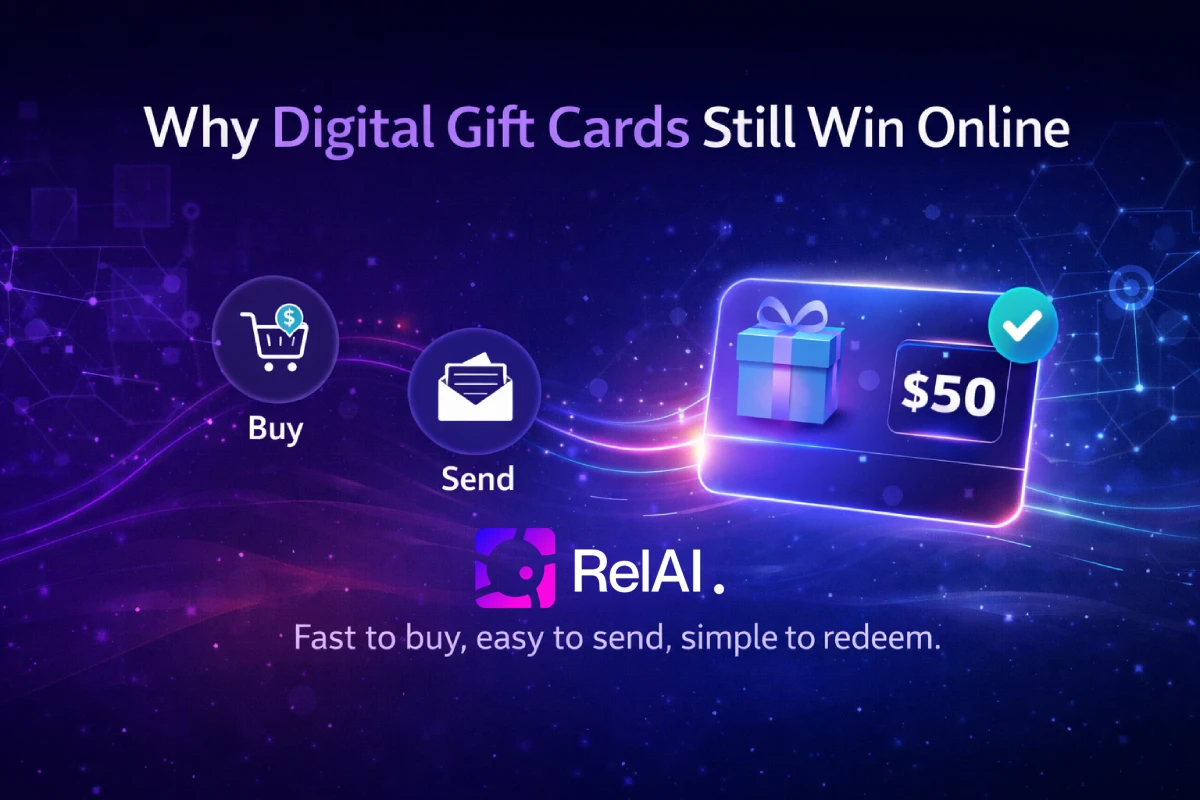
Today, digital gift cards are one of the most practical and effective internet-native products you can offer. They are fast to buy, easy to send, simple to redeem, and flexible enough to work for gifting, promotions, rewards, refunds, and customer acquisition.
Online, that combination matters a lot.
Why Gift Cards Work So Well Online
Most online products win or lose on one thing: friction.
The more steps you add, the more users drop off. The more complicated the experience feels, the less likely people are to complete it.
Digital gift cards fit modern user behaviour because they remove friction at every stage:
- Buying is fast
- Sending is instant
- Receiving is simple
- Redeeming feels familiar
That is exactly the kind of user flow the modern internet rewards.
They Solve a Real Problem: Choice Without Complexity
A good gift should feel personal.
But in practice, people often get stuck between two bad options:
- Buy a specific item and risk getting it wrong
- Send money and make the experience feel impersonal
They preserve the intent of a gift while giving the recipient room to choose what they actually want. That makes them useful not only for birthdays and holidays, but also for work bonuses, customer rewards, promotional campaigns, referral programmes, and one-off thank-you gestures.
In other words, a gift card is not just a fallback. It is often the most user-friendly format available.
Built for Last-Minute Internet Behaviour
A lot of online commerce is driven by urgency.
People remember an occasion late. Teams need to send a reward immediately. A support rep wants to resolve a problem with a credit or voucher on the spot. A marketer wants to launch a campaign without introducing new fulfilment operations.
Digital gift cards are ideal for these moments because they are:
- Instant
- Shareable
- Low-maintenance
- Easy to understand
A product that can be bought in seconds and delivered in a link is naturally aligned with how people already communicate online.
Why Businesses Love Them Too
From the customer side, the value is convenience.
From the business side, the value is much bigger.
Digital gift cards are one of the rare products that can improve multiple parts of a business at the same time.
1. They bring in new customers
A gift card often introduces someone to your brand for the first time.
The buyer may already be your customer. The recipient may not be. That means every gift card can function as a lightweight acquisition channel, especially when the redemption experience is smooth.
2. They increase basket size
Recipients frequently spend more than the value of the card itself. If someone receives a $25 card and wants a $38 product, the business wins twice: the original gift card sale and the incremental top-up.
3. They create better retention loops
Gift cards bring users back. They create a reason to revisit the app, website, or store. They also work well with seasonal campaigns, limited-time promotions, and loyalty mechanics.
4. They are operationally simple
Physical gifting creates logistics. Digital gifting does not.
No inventory. No shipping. No packaging. No returns because the wrong size was sent. From an operations perspective, digital gift cards are one of the cleanest products you can run.
The Best Gift Card UX Feels Invisible
The strongest consumer products do not ask users to learn a new system.
They feel obvious on first use.
That is exactly how digital gift cards should work.
A good gift card experience should follow a very simple pattern:
- Choose an amount
- Pay
- Share
- Redeem
The buyer should not need a tutorial. The recipient should not need onboarding just to understand what they received. The entire experience should feel closer to sending a link than performing a financial operation.
The best implementations usually share the same principles:
- Clear value — the recipient immediately sees what the card is worth
- Easy delivery — send by link, email, or message
- Low redemption friction — no unnecessary account creation or setup
- Strong visual presentation — the gift should feel polished, not like a raw coupon code
- Predictable expiry and terms — users should understand how and when to use it
More Than a Consumer Product
Gift cards are often framed as a retail feature, but they are much broader than that.
They also work well in:
- Customer support — issue store credit instead of processing a traditional refund path
- Marketing — run referral or promo campaigns with fixed-value rewards
- Communities — distribute perks to users without handling physical fulfilment
- B2B rewards — send incentives to partners, contractors, or contributors
- Product growth — create shareable credit that naturally pulls new users into the funnel
They are not just a commerce feature. They are a distribution and retention tool.
Why the Format Keeps Winning
There are many digital reward formats available today: promo codes, loyalty points, cashback, referral bonuses, account credits, coupons.
Gift cards keep winning because they combine the strongest parts of several models without inheriting all the downsides.
They are:
- easy to explain like a voucher
- flexible like store credit
- shareable like a link
- emotionally stronger than a discount code
- operationally simpler than physical gifting
They work for consumers because they feel generous and flexible. They work for businesses because they are measurable and scalable.
Simplicity Still Wins
Modern product design taught the industry an important lesson: users do not reward complexity just because the underlying system is sophisticated.
They reward outcomes.
If the result is fast, obvious, and trustworthy, adoption follows.
That is why digital gift cards remain so effective. They fit the mental model people already have:
- buy something for someone else
- send it instantly
- let them choose when to use it
And in product design, that is always a powerful advantage.
Final Thought
Digital gift cards are not a legacy ecommerce feature.
They are one of the clearest examples of a product that still works because it matches how people actually behave online: fast decisions, mobile sharing, lightweight interactions, and a strong preference for flexibility.
If you want a product that is simple for users, useful for businesses, and naturally suited to the internet, digital gift cards are still one of the best formats out there.
The best digital products reduce friction. Gift cards do exactly that: buy fast, share instantly, redeem easily.